How Much Do Subscription Creators Make? Realistic Math (2026)
How much subscription creators really keep: worked examples of platform fees, refunds, holds, churn, agency cuts and taxes, with IRS sources. Not tax advice.

Key takeaways
- There is no honest single earnings figure; build your own from subscribers, price, extra sales and churn.
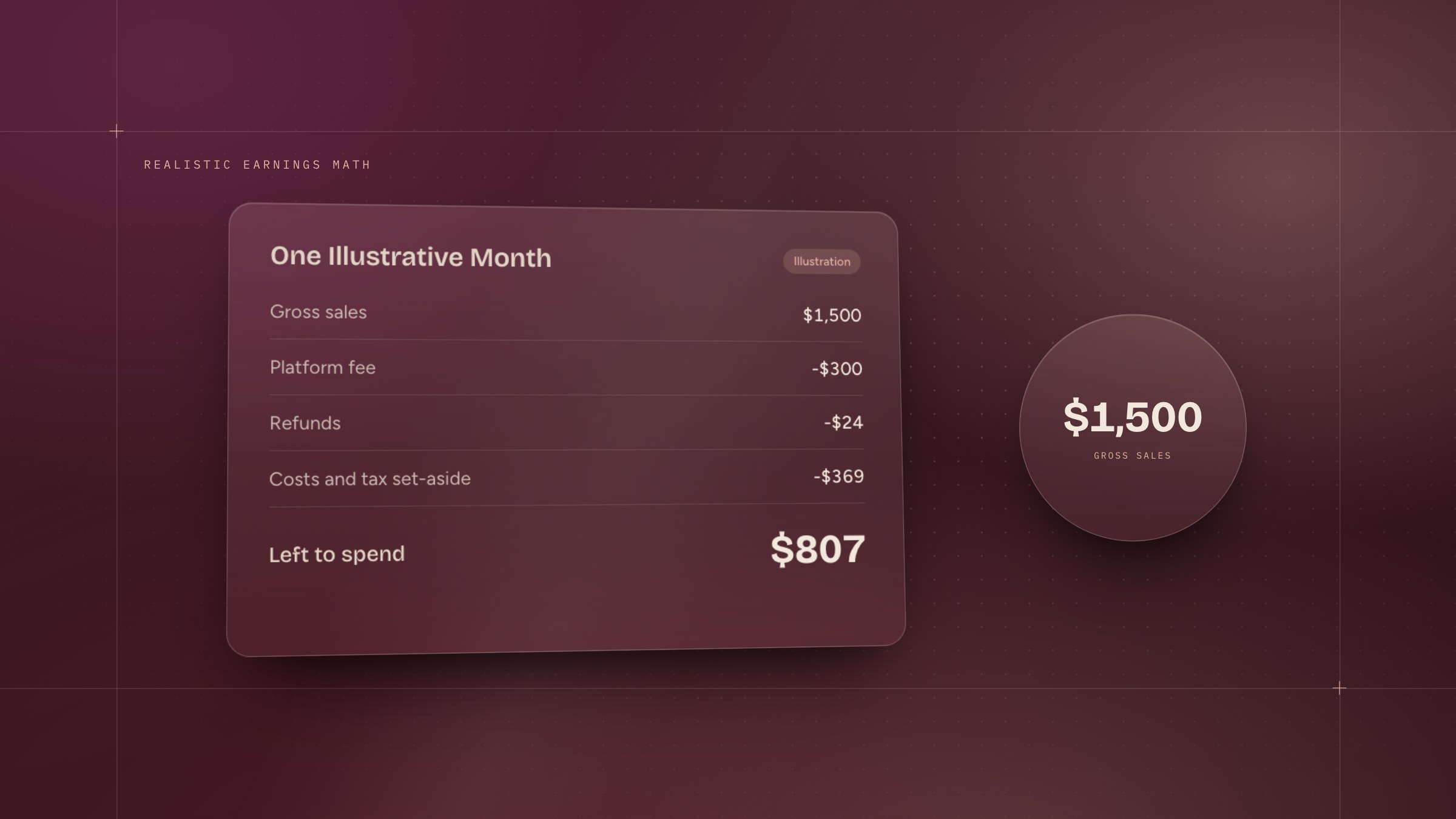
- After a 20% platform fee, refunds, any agency share, costs and tax, a $1,500 illustrative month leaves roughly $540 to $810 to spend.
- Churn decides next month: you have to replace every cancellation before you grow.
- US creators with $400 or more in net self-employment earnings generally owe self-employment tax (a 15.3% rate, per the IRS) on top of income tax, so set money aside from every payout. This is general information, not tax advice.
On this page
- Why Averages Tell You Very Little
- Step 1: Gross Sales Minus the Platform Fee
- Step 2: Refunds, Chargebacks and Holds
- Step 3: Churn, the Number That Decides Next Month
- Step 4: Agency Cuts and Collab Splits
- Step 5: Taxes and Business Costs
- Putting It Together: One Illustrative Month
- How to Keep More of What You Earn
- Frequently Asked Questions
Nobody can honestly give you one number for what subscription creators make, because earnings vary hugely from creator to creator. What you can work out is what your own sales leave you: start with gross sales, then subtract the platform fee, refunds and chargebacks, any agency or collab share, business costs and tax. Subscriber churn decides whether next month's starting number goes up or down.
This guide walks through each of those steps with worked examples. Every dollar figure in the examples is a made-up illustration to show the math, not a claim about what any creator earns. Competitor and tax facts are linked to official pages and dated November 2026. Money and tax sections are general information, not financial or tax advice.
We run Belnoir, so we use its rules as the example platform. Belnoir is pre-launch: creators can sign up, verify and build their page now, but card payments are in test mode while our card processor reviews the business, so the Belnoir numbers here describe how earnings work once payments go live.
Why Averages Tell You Very Little
Headline averages are the least useful earnings number for a creator. An average mixes a small group of very large accounts with many part-time or inactive ones, so it says little about what a typical page earns, and it says nothing at all about yours.
A better approach is to build your own forecast from three inputs you control or can measure:
- Subscribers: how many people pay you each month, and at what price.
- Extra sales: paid posts, paid messages, tips, store items and custom requests on top of subscriptions.
- Churn: how many subscribers cancel each month, and how many new ones you bring in.
Once you have those, the rest is subtraction. The sections below take one illustrative month of $1,500 in gross sales and follow it all the way to what is left to spend.
Step 1: Gross Sales Minus the Platform Fee
The platform fee is the first deduction, and usually the largest. As of November 2026, the OnlyFans terms say its fee is 20% of each fan payment, and Fanvue's legal pages set the standard creator earning rate at 80%. Check whether card processing or currency conversion costs come off on top on any platform you use, because that changes the real rate.
On Belnoir the fee is 20% on every plan, on subscriptions, store items, paid posts and messages, tips and custom requests, and card processing is covered by the service fee fans pay on top of the price. There is no payout fee. In our illustration:
- Gross sales: $1,000 from 100 subscribers at $10, plus $500 from paid posts, messages and tips, for $1,500.
- Belnoir fee: 20%, or $300.
- Your share: $1,200.
Belnoir's optional Pro ($29 a month) and Elite ($79 a month) plans keep the same 20% fee, so they do not change this math. They add tools such as BlackBook CRM™, the AI Chatter and team seats, and their price comes out of your share. Our fees and payouts guide covers when a paid plan is worth it, and the first 100 creators who claim a founding seat get Pro's tools free for six months.
Step 2: Refunds, Chargebacks and Holds
Refunds and chargebacks take back money you have already earned, and holds decide when you can actually be paid. Both affect your cash, so plan for them rather than treating every sale as final the moment it happens.
When a fan's refund or chargeback succeeds, platforms take back your share of that sale. The OnlyFans terms, for example, say it may deduct the creator earnings portion of a refunded or charged-back payment. On Belnoir, Belnoir also gives back its own fee on a refunded sale, so you return your share, not the full price. In our illustration, if $30 of the month's sales is refunded, you give back $24 (your 80%), leaving $1,176.
Holds are about timing, not lost money. On Belnoir each sale clears after 7 days, so the last week of any month is still pending at month end, and payouts go out weekly through Paxum, the only payout method today. Your first payout comes no sooner than 14 days after your first paid sale. Our fees and payouts guide compares hold periods and minimums across platforms, and Getting Paid has the current Belnoir details.
Clear descriptions, honest previews and quick replies to questions are the most reliable ways to keep refunds and disputes low.
Step 3: Churn, the Number That Decides Next Month
Churn is the share of subscribers who cancel in a month, and it matters more to long-run earnings than almost any fee. To work it out, divide the number of cancellations in a month by the number of subscribers you started the month with.
Here is an illustration. You start the month with 100 subscribers at $10. Twelve cancel, which is 12% churn, and eight new fans join. You begin next month with 96 subscribers, so your subscription income drops from $1,000 to $960 before you sell anything else. If the same 12% churn and eight new fans a month continued for six months, you would end near 82 subscribers, even though you gained new fans every single month.
Two things follow from this:
- Replacing cancellations is the baseline. Growth only starts once new subscribers outnumber the ones who leave.
- Keeping a fan is often cheaper than finding one. A welcome message, a regular posting rhythm and noticing who has gone quiet all help.
On Belnoir, BlackBook CRM™ shows your fan list and top spenders on every plan, with "reach out today" suggestions. Fan labels and private notes come with Pro. If you are moving fans from another platform, our guide to moving subscribers covers how to do it within each platform's rules.
Step 4: Agency Cuts and Collab Splits
If you work with an agency or split sales with a collaborator, that share is usually figured on your earnings after the platform has been paid. For creators who use an agency, it can be as large as the platform fee or larger, as the example below shows.
On Belnoir, you set and approve any agency percentage yourself, up to a limit of half of what you earn. Collab splits are figured the same way, from what the creator who made the sale keeps, and can add up to 90% of it.
In our illustration, an agency taking 30% of your $1,176 would receive $352.80, leaving you $823.20. Before you sign with anyone, ask what the percentage is taken from, what work it covers, how you can see the numbers, and how you can end the arrangement.
Step 5: Taxes and Business Costs
Tax is the deduction creators most often forget, because nothing comes off automatically for most self-employed people. In the US, most creators are self-employed, so they owe income tax plus self-employment tax on their net profit, and many need to pay during the year rather than all at once in April. This is general information, not tax advice.
- Self-employment tax: the IRS rate is 15.3% (12.4% Social Security plus 2.9% Medicare), and it applies once net earnings from self-employment reach $400 for the year. It is figured on 92.35% of net earnings, and the Social Security part stops at a yearly wage limit.
- Estimated payments: the IRS says people in business for themselves generally need to make estimated payments if they expect to owe $1,000 or more. The four payment dates are April 15, June 15, September 15 and January 15 of the following year.
- Business costs: ordinary costs of running your page, such as equipment, software or props, generally reduce your taxable profit. Keep receipts and records.
- Reporting: platforms may send a Form 1099 once your payouts pass an IRS reporting threshold, and those thresholds changed for 2026, but your income is taxable whether or not you get a form.
On Belnoir, a payout waits until a tax form is on file: a W-9 for US creators or a W-8BEN for creators outside the US. In general, the IRS backup withholding rate is 24% when a correct taxpayer number is missing. Creators outside the US owe tax under their own country's rules. A tax professional who knows creator income can tell you what to set aside.
US tax numbers to know
Putting It Together: One Illustrative Month
Put every step together and $1,500 in gross sales becomes a much smaller amount you can actually spend. The table below follows our illustration twice, once without an agency and once with a 30% agency share. The 25% tax set-aside is a placeholder to show the math, not a recommendation for your situation.
Without an agency, about $807 of the $1,500 is left to spend after costs and the tax set-aside. With the agency, about $542 is left. Neither number is a prediction: change the subscriber count, price, churn or costs and the result moves with them. The point is to run your own numbers with the same steps.
You can try different prices and plans on our fee calculator, and see exactly how payouts work on the creator payouts page.
From gross sales to take-home
- Step 1Gross sales$1,500 from subscriptions, paid posts, messages and tips (illustration).
- Step 2Platform feeBelnoir keeps 20% ($300). Card processing is covered by the fans' service fee, not taken from this.
- Step 3RefundsYour share of $30 in refunds ($24) comes back off.
- Step 4Agency shareOnly if you use one: 30% of what you keep in this example.
- Step 5Costs and taxSubtract business costs, then set money aside for tax.
| Step | Without an agency | With a 30% agency share |
|---|---|---|
| Gross sales in the month | $1,500 | $1,500 |
| Belnoir fee (20%, card processing included) | -$300 | -$300 |
| Your share of $30 in refunds | -$24 | -$24 |
| Agency share (30% of what you keep) | $0 | -$352.80 |
| Business costs (example) | -$100 | -$100 |
| Tax set-aside (25% placeholder) | -$269 | -$180.80 |
| Left to spend | $807 | $542.40 |
How to Keep More of What You Earn
Most of the gap between gross sales and take-home pay is fixed, but a few habits make a real difference over a year.
- Track churn monthly. It is the number that decides whether next month starts higher or lower.
- Price for retention. A fair subscription price with paid extras often keeps fans longer than a high price they cancel.
- Prevent disputes. Accurate previews and quick replies keep refunds and chargebacks down.
- Read any agency deal closely. Know what the share comes from and what it pays for.
- Set money aside for tax from every payout, and keep records of business costs.
- Spread your risk. Running two platforms means one platform's decision cannot pause all of your income.
Belnoir welcomes ID-verified creators from anywhere except the UK, Cuba, Iran, North Korea and Syria. If you would like to get your page ready before card payments open, becoming a creator takes about three minutes.
Frequently Asked Questions
How much do subscription creators make on average?
There is no reliable single figure, and averages mix a few very large accounts with many small or inactive ones. A more useful number is your own: subscribers times price, plus extra sales, minus the platform fee, refunds, any agency share, costs and tax.
How much of each sale does a creator keep?
As of November 2026, OnlyFans' terms set a 20% fee and Fanvue's standard creator earning rate is 80%, so creators there keep about 80% before tax. On Belnoir you keep 80% on every plan, including the paid Pro and Elite plans, and card processing is covered by the fan's service fee.
What happens to my earnings when a fan gets a refund?
Your share of that sale is taken back, usually from pending money or your next payout. On Belnoir, Belnoir also returns its own fee, so you give back your share rather than the full price.
How do I calculate subscriber churn?
Divide the number of subscribers who cancelled during a month by the number you had at the start of that month. If 12 of 100 cancel, your monthly churn is 12%.
How much should creators set aside for taxes?
It depends on your country, income and costs, so ask a tax professional. In the US, the self-employment tax rate is 15.3% (Social Security plus Medicare) once net earnings reach $400 for the year, and the IRS generally expects estimated payments if you will owe $1,000 or more. This is general information, not tax advice.
Sources
- OnlyFans Terms of Service, checked November 11, 2026
- Fanvue Creator Earnings and Payouts, checked November 11, 2026
- Fanvue Creator Terms, checked November 11, 2026
- IRS: Self-Employment Tax (Social Security and Medicare Taxes), checked November 11, 2026
- IRS: Estimated Taxes, checked November 11, 2026
- IRS FAQ: Estimated Tax Payment Periods and Due Dates, checked November 11, 2026
- IRS: Backup Withholding, checked November 11, 2026
- IRS: Deducting Business Expenses, checked November 11, 2026
Other platforms' terms change. Figures were checked against the sources above on November 11, 2026. This article is general information, not financial, tax or legal advice.
More from the Blog
All articles
Guides
How to Protect Your Content From Leaks (2026 Creator Guide)
How creators protect paid content from leaks: watermarks and leak tracing, blocked downloads, finding copies, DMCA takedown basics and what Belnoir does for you.
· 9 min read

Comparisons
OnlyFans vs Fansly for Creators: Fees, Payouts and Rules (2026)
OnlyFans vs Fansly for creators in 2026: a neutral, sourced comparison of fees, payouts, holds, minimums, discovery, verification and content rules.
· 8 min read
Growth
How to Switch From OnlyFans to Another Platform Safely
A practical guide to moving subscribers to a new platform: running two pages side by side, telling fans, pricing a launch offer, timing and what to avoid.
· 9 min read