Creator Platform Fees and Payouts Explained (2026 Guide)
How creator platform fees and payouts work in 2026: platform share, card processing, holds, minimums, payout methods and W-9, W-8BEN and 1099 basics.

Key takeaways
- Most major platforms take about 20%, so creators keep roughly 80% before tax.
- Who pays card processing, the hold period and the payout schedule decide what actually reaches you.
- On Belnoir, a $100 sale leaves you $80: processing is covered by the fan's service fee, and there is no payout fee.
- US creators sign a W-9 and non-US individuals a W-8BEN. This guide is general information, not tax advice.
On this page
- The Six Terms That Decide Your Take-Home Pay
- Platform Fee vs Card Processing: Who Pays Which
- A Worked Example: Where a $100 Sale Goes
- Hold Periods, Payout Schedules, Minimums and Methods
- How Refunds, Chargebacks and Account Holds Affect Your Payout
- Tax Forms: W-9, W-8BEN and 1099 Basics
- When a Paid Plan Is Worth It
- How Belnoir Handles Fees and Payouts
- Frequently Asked Questions
Most major subscription creator platforms take about 20%, so you keep roughly 80% of each sale before tax and any currency or bank fees. What actually reaches your bank also depends on who pays card processing, how long each sale is held, the payout minimum and schedule, the payout method, and which tax form you file.
This guide walks through each of those pieces in plain terms, with a worked example of a $100 sale. Competitor terms were checked on the platforms' own pages as of November 2026, and every source is listed at the end. Terms change, so check the current version before you rely on any number. Money and tax sections are general information, not financial or tax advice.
We run Belnoir, so we use it as one worked example with the numbers from our own payout rules. Belnoir is pre-launch: card payments are in test mode while our card processor reviews the business, so every Belnoir figure in this guide describes how payouts work once card payments go live.
The Six Terms That Decide Your Take-Home Pay
Your take-home pay comes down to six things: the platform fee, who pays card processing, the hold period, the payout minimum, the payout schedule and the transfer time. Platforms often advertise only the first one. Here is what each means in one line.
- Platform fee: the share of each sale the platform keeps, usually a percentage.
- Card processing: what the card network and processor charge to take a fan's payment. Some platforms absorb it inside their fee, others pass some costs on.
- Hold period: how long a sale stays pending before you can be paid for it. It exists to cover refunds and chargebacks.
- Payout minimum: the smallest balance the platform will send. Smaller balances usually roll forward.
- Payout schedule: how often money goes out, such as daily, weekly or on request.
- Transfer time: how long the payout method takes to land once the platform sends it. A bank transfer and an e-wallet can differ by days.
Two platforms with the same 20% fee can still pay you on very different timelines, which matters most when you are starting out.
Platform Fee vs Card Processing: Who Pays Which
On the major platforms the headline fee is 20%, but the fine print on processing and currency costs differs. Read the terms for three things: what the percentage is taken from, whether processing comes off separately, and what happens when your payout needs a currency conversion.
- OnlyFans: its terms (last updated October 2026) set the fee at 20% of the total fan payment, deducted from each payment, and list no separate card-processing fee for creators. The same terms say payouts that need a currency conversion include conversion fees, and bank fees on international transfers fall on the creator.
- Fanvue: its legal pages set the standard creator earning rate at 80%. Earnings are described as exclusive of taxes, fees or third-party processing charges, and the terms do not clearly say who bears processing.
- Fansly: none of the Fansly help pages we read states a fee percentage. Third-party guides report 20%, which we could not confirm on Fansly's own pages.
If you work with an agency, its share usually comes out of what you keep, not out of the platform's fee. On Belnoir, for example, the agency share is a percentage the creator agrees to, capped at 50%, taken from the creator's earnings after Belnoir's fee.
Belnoir's fee is 20% on every plan, so creators keep 80%. Card processing is covered by the fan's service fee (10% + $0.35, added on top of the price), so nothing for processing comes off the creator's share, and there is no payout fee.
A Worked Example: Where a $100 Sale Goes
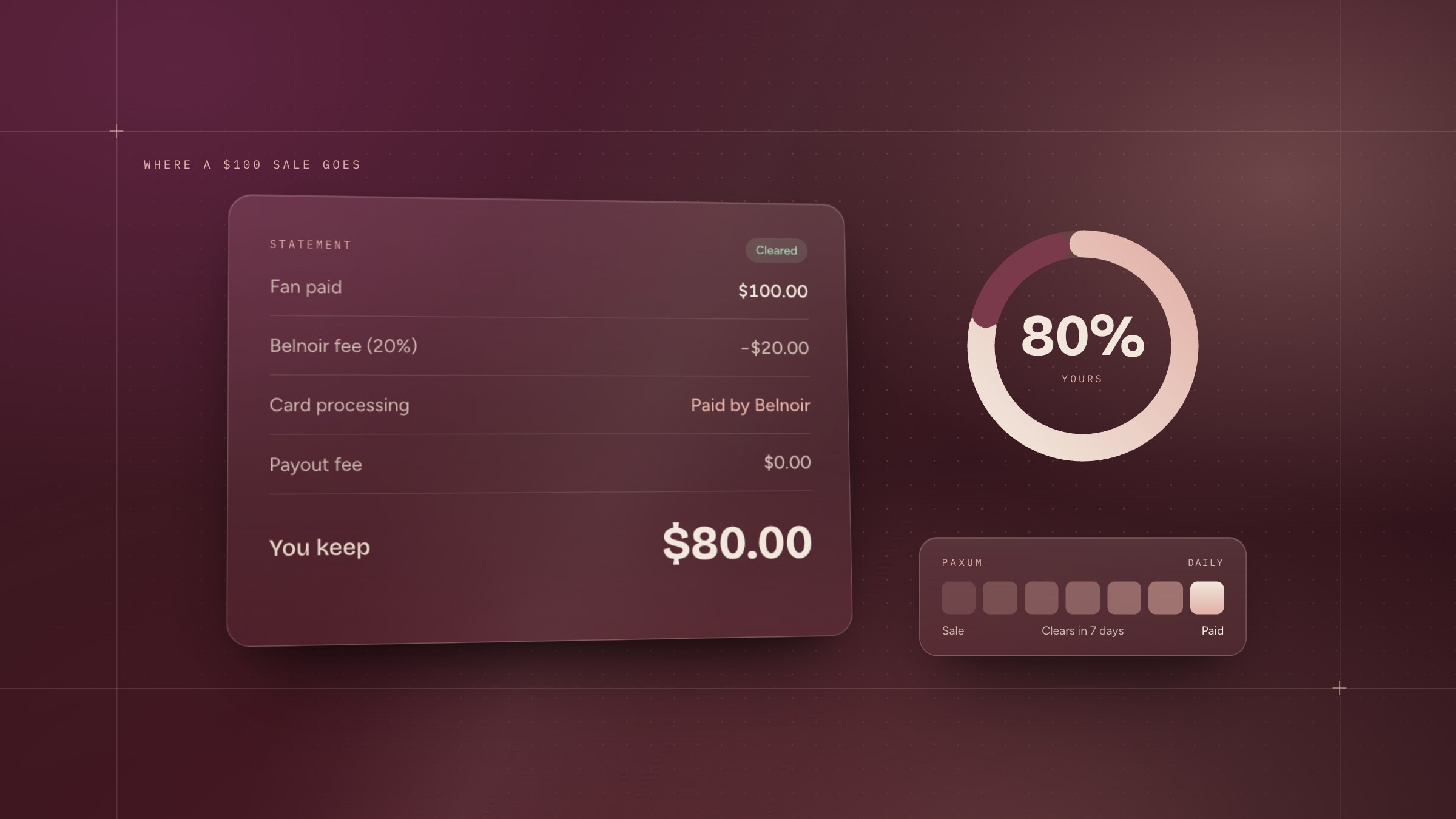
On a 20% platform that absorbs processing, a $100 sale leaves you $80 before tax. The platform's $20 has to cover card processing and everything else it runs. If a platform passed processing on separately, your share would be lower than the headline suggests.
Here is the same $100 sale step by step on Belnoir. The fee is the same on every plan:
- A fan pays $100 for a store item, a pay-per-view post or a subscription.
- Belnoir's 20% fee, $20, comes off at the moment of sale. Card processing doesn't come off your $80: the fan pays a service fee of 10% + $0.35 on top of the $100, which covers it.
- Your balance shows $80 as pending.
- After the 7-day hold, the $80 becomes available.
- It goes into the next weekly payout. Your first payout comes no sooner than 14 days after your first paid sale and always waits for a check by a person. No payout fee comes off.
If you work with an agency that takes 30% of what you keep, $24 of that $80 goes to the agency and $56 stays with you. The paid plans leave the same $80, because they add tools rather than lower the fee. The table below compares them.
Belnoir · A $100 sale
| Plan | Monthly price | Belnoir fee | You keep from $100 | What the plan adds |
|---|---|---|---|---|
| Essentials | Free | 20% ($20) | $80 | Everything you need to sell |
| Pro | $29 (billed from earnings) | 20% ($20) | $80 | BlackBook CRM™ labels and notes, Publish To, 4K Video Editor, 2 team members |
| Elite | $79 (billed from earnings) | 20% ($20) | $80 | Everything in Pro, Full AI mode, all automations, 10 team members |
Hold Periods, Payout Schedules, Minimums and Methods
Fansly and Fanvue both publish a 7-day hold, which Fanvue can extend to 28 days, and a $20 minimum is common for e-wallets and local bank transfers. The real differences are in how often you are paid, which methods you can use, and how long each method takes.
- Fansly: after each sale, funds enter a 7-day pending period, and payout requests are usually approved within 48 hours. International wires and crypto are sent in batches every three days. Minimums are $20 for Paxum, Cosmopayment and local bank deposits where offered, $50 for SEPA, $100 for international wire, and $50 to $100 for crypto. Bank payouts arrive in 1 to 3 business days, while Paxum, crypto and Cosmopayment often arrive within 24 hours.
- Fanvue: the pending period is 7 days and can be extended to 28. The minimum is $20, varying by region, and you need at least five pieces of content. Payouts typically arrive within 3 to 5 business days depending on the method, though Fanvue's terms allow up to 10 business days to process a request.
- OnlyFans: the terms require a minimum payout balance but do not state the amount in the terms themselves. Third-party guides commonly cite $20, which we could not confirm on OnlyFans' own pages.
On Belnoir, each sale clears after 7 days, and payouts go out weekly. Your first payout comes no sooner than 14 days after your first paid sale. At launch, payouts go through Paxum. Bank payouts will follow and are not available yet. The minimum is $20, and anything smaller rolls into the next payout. A person reviews certain payouts before they go out, including your first payout, any payout over $5,000, and any payout to an account changed in the last 48 hours. The full schedule is on the How You Get Paid page and in Getting Paid.
Belnoir · From sale to payout
- Day 0A fan paysBelnoir's fee comes off at the moment of sale.
- Days 1 to 7It clearsHeld to cover refunds and chargebacks.
- Day 7AvailableShows as available on your Statements page.
- Every weekPaid outCleared earnings go out weekly, with no payout fee.
How Refunds, Chargebacks and Account Holds Affect Your Payout
Refunds and chargebacks are the main reason platforms hold sales before paying them out. If a fan's refund or dispute succeeds, the platform takes back your share of that sale, either from pending money or from your next payout. Repeated disputes can also lead to longer holds or a reserve.
- OnlyFans: if a fan wins a refund or chargeback, OnlyFans may deduct the creator's share of that payment. Like most platforms, its terms also let it withhold earnings while it looks into a suspected breach.
- Fanvue: it may charge a $50 administrative fee for each extra dispute once your dispute rate goes over 1.5% in any rolling 30 days, though it can waive the fee.
Here is how Belnoir does it: the 7-day hold is there to cover refunds and chargebacks. Belnoir may also hold a reserve, but only for a documented reason: the card processor requires it, refunds or chargebacks are unusually high, a specific refund, chargeback, legal or safety matter is open, or suspected fraud or a breach is being looked into. You can see each hold, its amount and reason in your dashboard, and reserves are reviewed at least every 30 days. A payout is also held for a person to review when refunds and chargebacks go over 5% of sales.
Whichever platform you use, clear descriptions, honest previews and quick replies to fan questions are the best protection against disputes.
Tax Forms: W-9, W-8BEN and 1099 Basics
Most US-based platforms ask for a tax form before your first payout. US creators fill in Form W-9, creators outside the US who are individuals usually fill in Form W-8BEN, and US creators may receive a Form 1099 reporting what they were paid. This is general information, not tax advice.
- Form W-9: for US persons. It gives the platform your name and taxpayer identification number. If a W-9 is missing or the number is wrong, the payer may have to apply backup withholding, which the IRS sets at 24%.
- Form W-8BEN: for non-US individuals. It certifies that you are not a US person and can claim a reduced rate under a tax treaty where one applies. You still owe tax where you live, under your own country's rules.
- Form 1099: a year-end report of what a US creator was paid, sent in January when the payments reach the federal reporting threshold. Those thresholds changed for 2026 payments, but your income is taxable whether or not you receive a form.
- Self-employment tax: most US creators are self-employed, so they pay Social Security and Medicare on their net earnings (15.3% combined, per the IRS) on top of income tax. Many set aside part of each payout and make quarterly estimated payments.
On Belnoir, every creator signs a W-9 or W-8BEN before their first payout, and US creators get a Form 1099 each January if their payouts reach the IRS reporting threshold. Once you earn regularly, many creators find it helps to work with a tax professional who knows their country's rules.
When a Paid Plan Is Worth It
Some platforms sell paid plans with a lower fee. On Belnoir the fee is 20% on every plan, so a paid plan does not change what you keep from a sale. It is worth it when its tools save you time, earn you more, or replace something you already pay for.
Using Belnoir's plans as the example:
- Pro costs $29 a month or $290 a year. It adds BlackBook CRM™ labels and private notes, Publish To, the Video Editor in 1080p and 4K, 2,000 AI Chatter replies a month, five automations, two team members and all-time statistics.
- Elite costs $79 a month or $790 a year. It adds the AI Chatter's Full AI mode with 15,000 replies a month, all 20 automations and ten team members.
- A quick test: add up what the tools replace. If two team seats let a helper answer messages instead of an agency taking 30% of what you keep, that agency share on $1,000 in monthly sales would be $240, against $29 for Pro. If you would not use the tools, the free plan leaves you exactly the same 80%.
On Belnoir, plans are billed from earnings, never from a card, and a plan only starts or renews when your earnings cover it. Elite has a 14-day trial that never turns into a paid plan by itself, and the first 100 approved creators who claim a founding seat get Pro's tools free for six months, at the usual 20% fee.
Belnoir · What each plan adds
- AI Chatter: 100 replies a month
- Fan list and top spenders
- Video Editor up to 720p
- Statistics for the last 30 days
- AI Chatter: 2,000 replies a month
- 5 automations
- BlackBook CRM™ labels and notes
- Publish To
- Video Editor up to 4K
- 2 team members
- All-time statistics
- AI Chatter: 15,000 replies a month, Full AI mode
- All 20 automations
- BlackBook CRM™ labels and notes
- Publish To
- Video Editor up to 4K
- 10 team members
- All-time statistics
How Belnoir Handles Fees and Payouts
Belnoir creators keep 80% on every plan, and card processing is covered by the fan's service fee, not taken from creators. Sales clear in 7 days, payouts go out weekly, the minimum is $20, and there is no payout fee. These terms apply once card payments go live.
- Fee: 20% on every plan: Essentials (free), Pro and Elite. Paid plans add tools, not a lower fee. No processing deducted from creators.
- Hold and schedule: 7 days to clear, then paid weekly. Your first payout comes no sooner than 14 days after your first paid sale.
- Minimum: $20, with smaller balances rolling forward.
- Payout method: Paxum at launch. Bank payouts are planned but not available yet.
- Tax: W-9 or W-8BEN before your first payout, and a Form 1099 each January for US creators whose payouts reach the IRS reporting threshold.
- Who can join: ID-verified creators from anywhere Belnoir is open, which is everywhere except the UK, Cuba, Iran, North Korea and Syria.
To be straightforward about where we are: Belnoir is new, pre-launch and its fan audience is still small, so most creators add it alongside a platform they already use. You can compare the numbers side by side, read how payouts work, or apply as a creator and get your page ready before card payments open.
Frequently Asked Questions
How much do creator platforms take from each sale?
Most major subscription platforms take about 20%, so creators keep roughly 80% before tax. As of November 2026, OnlyFans' terms set a 20% fee and Fanvue's legal pages set an 80% creator earning rate. Belnoir's fee is also 20%, on every plan, including its paid Pro and Elite plans.
Does the platform fee include card processing?
It depends on the platform. OnlyFans' terms list no separate processing fee for creators but pass currency conversion fees on payouts that need one. Fanvue's terms do not clearly say who bears processing. On Belnoir, card processing is covered by the fan's service fee (10% + $0.35, added on top of the price), so nothing for processing comes off the creator.
How long does it take to get paid?
Expect about a week before a sale can be paid out, plus approval and the payout method's transfer time, which ranges from about a day for e-wallets to several business days for bank transfers. Fansly and Fanvue both use a 7-day pending period. On Belnoir, sales clear in 7 days and payouts go out weekly. Your first payout comes no sooner than 14 days after your first paid sale and is checked by a person.
What is the minimum payout?
A $20 minimum is common for e-wallets such as Paxum and for local bank transfers, while international wires often need $100. Belnoir's minimum is $20, and smaller balances roll into the next payout.
Which tax form do I need as a creator?
US creators usually fill in Form W-9, and individuals outside the US usually fill in Form W-8BEN. US creators may then receive a Form 1099 in January, depending on how much they were paid. This is general information, not tax advice, so check with a tax professional about your own situation.
Is a paid creator plan worth it?
On Belnoir, a paid plan does not lower the fee, which is 20% on every plan. Pro ($29 a month) and Elite ($79 a month) are worth it when their tools, such as BlackBook CRM™, the AI Chatter and team seats, save you time or replace something you already pay for, like an agency or other paid tools.
Sources
- OnlyFans Terms of Service (last updated October 2026)
- Fansly Help: Payout Processing Times
- Fansly Help: Payout Minimums by Method
- Fansly Help: Where Are My Earnings
- Fansly Help: Alternative Payout Methods
- Third-party report of Fansly's 20% fee (unconfirmed on Fansly's own pages; policy version December 2024)
- Fanvue Creator Terms
- Fanvue Creator Earnings and Payouts
- Fanvue Help: How to Receive a Payout
- Third-party OnlyFans payout guide citing a $20 minimum (unconfirmed)
- IRS: About Form W-9
- IRS: About Form W-8BEN
- IRS: Backup Withholding
- IRS: Self-Employment Tax
- IRS: Estimated Taxes
Other platforms' terms change. Figures were checked against the sources above on November 11, 2026. This article is general information, not financial, tax or legal advice.
More from the Blog
All articles
Guides
How to Protect Your Content From Leaks (2026 Creator Guide)
How creators protect paid content from leaks: watermarks and leak tracing, blocked downloads, finding copies, DMCA takedown basics and what Belnoir does for you.
· 9 min read
Money
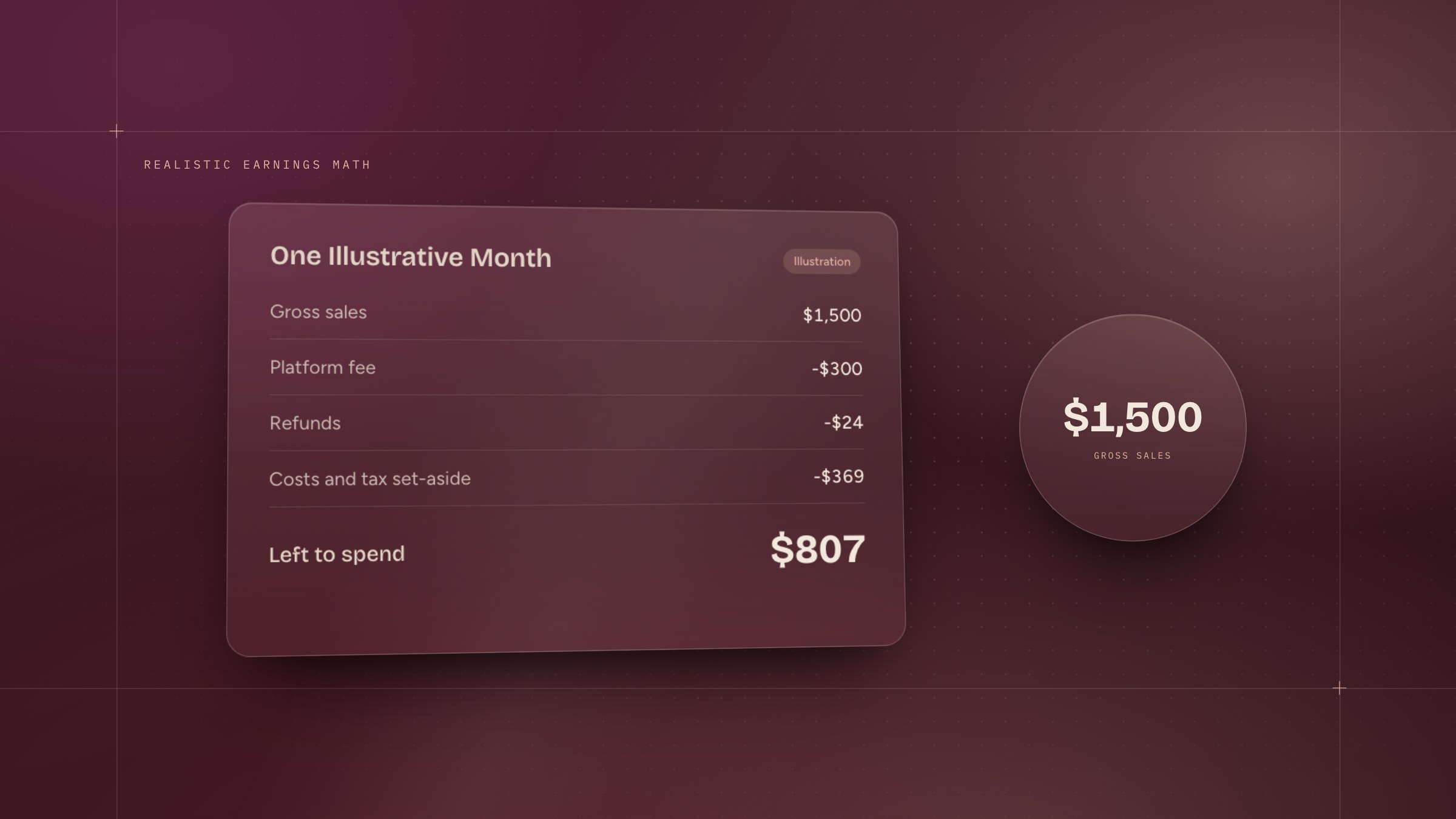
How Much Do Subscription Creators Make? Realistic Math (2026)
How much subscription creators really keep: worked examples of platform fees, refunds, holds, churn, agency cuts and taxes, with IRS sources. Not tax advice.
· 9 min read
Comparisons
OnlyFans vs Fansly for Creators: Fees, Payouts and Rules (2026)
OnlyFans vs Fansly for creators in 2026: a neutral, sourced comparison of fees, payouts, holds, minimums, discovery, verification and content rules.
· 8 min read